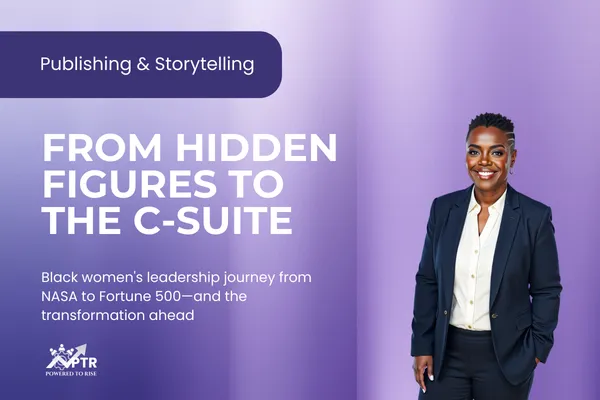
From Hidden Figures to the C-Suite: Black Women's Leadership Journey from NASA to Fortune 500—and the Transformation Ahead

In American history, progress for Black women in leadership has never been linear. It has been a story of opportunities seized during moments of national crisis or intentional planning months, sometimes years, in advance. This Black History Month, the arc from NASA's "hidden figures" to the Fortune 500 C-suite illuminates not only how rarely opportunity has been granted, but how brilliantly Black women have pushed the boundaries of what's possible for our nation. These stories teach us how to build bridges toward progress that don't rely on rare circumstances—pathways we can create ourselves.
When National Security Superseded Racism
The story begins in a segregated America, in West Virginia classrooms where teachers recognized brilliance in a young Katherine Johnson. They created custom curriculum for her, despite not knowing what opportunities might exist for a Black woman mathematician in a country that systematically denied her humanity.[1]

Alongside her contemporaries Dorothy Vaughan and Mary Jackson, Johnson would become part of a rare window in American history when national urgency temporarily superseded systemic barriers. The space race created an "all hands on deck" moment where Black women's mathematical genius became essential to national security. Fear of losing to Russia opened breathing room for Black talent to contribute in ways peacetime America would never have permitted.[2]
These women didn't wait for permission. When a narrow opening appeared because geopolitical urgency temporarily loosened the grip of segregation, they were ready. Their work as "human computers" at NASA's Langley Research Center in Hampton, Virginia was fundamentally crucial to America's space program success—they were often better suited for the complex mathematical computations than their male counterparts.
This moment created something else, too: scaffolding. It made government work one of the few havens where Black women could build economic stability. That pattern persists today, with Black women overrepresented in government roles compared to the private sector—a direct legacy of that small window during segregation.
The Fortune 500 Record: Four Women, Four Stories
Fast forward to our present landscape. In the entire history of the Fortune 500, only four Black women have held permanent CEO roles. Their stories fall into two distinct categories: intentional succession and constrained leadership.
Blueprints for Success: Burns and Duckett
Ursula Burns (Xerox, 2009-2016) represents what intentional leadership development looks like. She was groomed throughout her career within Xerox, starting as an intern and strategically positioned across different functions. Her career path was intentionally parallel-pathed with outgoing CEO Anne Mulcahy, creating the first woman-to-woman CEO transition in Fortune 500 history.[3]
This was not accidental. It was a strong, well-executed succession plan where Burns was positioned to complement and supplement the existing CEO's work. Their shared partnership during the transition years strengthened Burns' position when she seamlessly stepped into the CEO seat.
Thasunda Duckett (TIAA, 2021-current) benefited from similarly intentional design. Following Roger Ferguson in the first Black-to-Black Fortune 500 CEO transition, the handoff was engineered with a gradual dial-down of Ferguson's presence while clearly installing Duckett to lead, not shadow. She received intentional support that empowered her to have meaningful impact from the start.
She remains the only Black woman currently leading a Fortune 500 company.
Leadership Under Constraint: Brewer and Townes-Whitley
The other two stories reveal how organizational design shapes what leaders can achieve.
Rosalind Brewer came to Walgreens in March 2021 with a strong track record. She had spent several years as COO of Starbucks, where she led operations for stores worldwide and was widely recognized for her work transforming customer experience and accelerating digital transformation during the pandemic.
She arrived during an unprecedented moment in corporate America. George Floyd's murder in May 2020 had sparked a national reckoning on racial justice. Companies across industries were examining their leadership, practices, and commitments to diversity. The post-COVID landscape was reshaping retail and healthcare delivery. Walgreens needed someone who understood both consumer experience and digital transformation.
But the succession structure itself shaped what was possible. Brewer was appointed to work alongside the outgoing CEO in a co-leadership model before fully taking the helm. The structure limited her range of authority during a critical transformation period for the company.
She stepped down in September 2023 after two and a half years. Her departure teaches us that even exceptional leaders with proven track records need succession structures that fully empower them to lead.
Toni Townes-Whitley arrived at SAIC in 2023, leading a company whose revenue depends almost entirely on government contracts—the same sector that provided scaffolding for Black women's economic stability since Katherine Johnson's era at NASA.
In January 2025, the second Trump administration issued executive orders restricting DEI initiatives and gender-related policies across federal agencies and contractors. In October 2025, Townes-Whitley stepped down, less than two years into her tenure.

The timing raises questions worth sitting with: What happens when a Black woman leads a government contractor at the precise moment the administration issues policy directives many view as hostile to diverse leadership? What choices face a leader when who she is might be perceived as counter to her company's interests? What conversations happen behind closed doors when business imperatives and leadership identity collide?
We don't have answers. We have a pattern: government work opened pathways for Black women during the space race. Now, current administrative policy may be narrowing those same inroads that have provided economic stability within the Black community for decades.
The Healthcare Connection: Why Leadership Diversity Is Critical
Nationally, Black populations have the poorest performing health outcomes. These measures are deeply connected to systemic racism, including economic disparities—differences in salary, household income, and other growth opportunities available within the Black community.
Zip code is the most correlative data point for projecting life outcomes in America, determining school quality, air quality, food access, educational pathways, and healthcare access. Income serves as a high-leverage point that can buffer downstream challenges, while downstream improvements don't necessarily lead to higher income.
The disconnect: People who originated from the hardest-hit communities are best positioned to see the challenges and gaps in healthcare delivery. Yet they are consistently underrepresented at the leadership tables where healthcare systems are designed.
During the pandemic, this gap had measurable consequences. People were living in a "multiverse"—vastly different versions of America depending on background and community. For many from privileged backgrounds, the pandemic felt like a nuisance disrupting normal life. For communities of color, the impact was catastrophic and disproportionate: higher death rates, more severe debilitation, higher rates of long COVID, and more severe nervous system impacts.
When leadership tables don't install people who understand this lived reality, systems get designed from the perspectives of those who sit at the table—not necessarily the circumstances that are in most urgent need of solutions.
The Displacement Creates the Opening to Build a Stronger Healthcare System
That gap between healthcare systems and the communities they serve has now become an opportunity for transformation. In 2025, Black women's employment rate fell by 1.4 percentage points to 55.7%—one of the sharpest one-year declines in the last 25 years.[4]
Between February and July 2025, Black women lost an estimated 319,000 jobs across the U.S. labor market, losses largely attributed to federal workforce reductions.
This wasn't random. While Black women represent approximately 12% of the federal workforce, they accounted for 33% of federal job cuts during major downsizing periods in 2025—nearly triple their representation.[5][[6]](https://ourpublicservice.org/fed-figures/a-profile-of-the-2023-federal-workforce/#:~:text=Race & Ethnicity,the U.S. labor force%2C respectively.) The rate of decrease was even more dramatic: Black women saw a 30% decrease in their federal employment, nearly triple the 11.6% drop seen for all women and significantly higher than the 8.1% drop for men.[4]
The Department of Government Efficiency (DOGE) initiatives reduced Black women's federal employment by 25% by August 2025. No statistically significant effect was found for other demographic groups.
These aren't just numbers. These are hundreds of thousands of professionals who have spent their careers in federal healthcare, policy implementation, and systems design—the very expertise healthcare organizations need to close the gaps that cost lives during the pandemic. They understand how public systems work and where they fail. They've seen firsthand where crisis response infrastructure breaks down and which communities get left behind.
Their lived experience positions them to see what others miss: how symptoms present differently across skin tones, why zip code predicts health outcomes, where care delivery fails communities that need it most, and how to design systems that work for populations historically overlooked.
This displacement redirects critical expertise from a contracting government sector to organizations ready to transform healthcare delivery. The question isn't whether this workforce is qualified—it's which organizations will move first to build with them.
The Reskilling and Redeployment Opportunity
The displacement of Black women from federal work creates an unprecedented opportunity for healthcare systems ready to transform.
During the COVID-19 pandemic, the documentary The Color of Care revealed systemic failures in American healthcare that had deadly consequences for Black communities. Physicians trained from textbooks that rarely featured anything but white skin. Pulse oximeters and triage protocols that did not account for how symptoms manifested on darker skin, leading to delayed care and improper prioritization for ventilators. Crisis response infrastructure concentrated where hospitals were located, not where the hardest-hit essential workers and their communities lived.[7]
In Hinds County, Mississippi, which accounted for only 6% of the state's total COVID deaths, Black residents represented 53% of those deaths. The disparity was not accidental. It was structural.[7]
The people who lived through this pandemic—who witnessed firsthand where the public healthcare system failed—are the very people best positioned to design solutions that work. Black women in federal healthcare roles saw the gaps, understood the compassionate load required in care delivery, and held the lived context to know what empathy in systems design requires.
These displaced professionals are now positioned to bring their expertise to organizations beyond government constraints. They can modernize healthcare technology infrastructure with an understanding of how those systems must serve communities historically left behind. They understand that zip code determines life expectancy, that co-morbidities concentrate in under-resourced communities, and that crisis response cannot wait until emergency strikes to address structural deficits.

The pandemic left nearly a million lives lost and provided quantitative proof of what healthcare infrastructure gaps cost. These displaced Black women professionals carry the knowledge to close those gaps. Healthcare systems, tech companies, consulting firms, and community organizations now have access to talent that understands both the technical requirements and the human stakes. The question is not whether they are qualified. The question is which organizations will move first to build with them.
Building New Pathways
The government sector's contraction redirects talent toward organizations ready to receive it. The private sector, healthcare systems, technology companies, and community organizations now have unprecedented access to professionals who understand public systems, healthcare delivery, and infrastructure design.
This moment requires strategic action from multiple directions:
For displaced professionals: Identify organizations positioned for healthcare transformation—tech companies building care delivery platforms, consulting firms advising health systems, community health organizations, and private healthcare companies. Your expertise in navigating public systems, understanding policy constraints, and designing for under-resourced communities is exactly what these organizations need to build solutions that actually work.
For organizations: Recognize this as the moment to build teams that reflect the communities you serve. Katherine Johnson's teachers prepared her without knowing what doors would open. When the window cracked, she was ready. Right now, experienced professionals are ready. The question is which areas within your organization are prepared to receive them, empower them, and architect new systems and approaches with them.
For all of us: Build now. Create new economic pathways that minimize dependency on government funding or policy structures. Establish consulting practices, join organizations positioned for transformation, build networks that connect talent to opportunity. While we work to restore protective policies, we also build infrastructure that can sustain us regardless of which way partisan winds blow.
What We're Building Together
The arc from hidden figures to Fortune 500 leadership teaches us that hope is vital, but it's not a strategy. Ours is a story of Black women preparing without permission before the destination was visible, seizing moments when they appeared, and building scaffolding for those who followed.
Only four Black women have ever held permanent Fortune 500 CEO roles. Only one remains. Yet 319,000 Black women professionals with a wide range of talent and expertise are now positioned throughout the economy. Many carry knowledge about public systems, healthcare delivery, policy implementation, and infrastructure design that organizations desperately need.
This Black History Month, we honor the brilliance that has always existed. We honor Katherine Johnson's teachers who prepared her without knowing what doors would open. We honor the organizations that built intentional succession pipelines. And we commit to building economic bridges that don't depend on rare circumstances or history-making catalytic moments—pathways we create, control, and sustain ourselves.
The door may be closing in one place. We are opening windows everywhere else.
Resources:
Book: by Margot Lee Shetterly: Hidden Figures
Book: by Katherine Johnson My Remarkable Journey: A Memoir
Book: by Ursula Burns: Where You Are Is Not Who You Are: A Memoir
Documentary: Presented by Oprah Winfrey: The Color of Care
Report: Three charts on diversity in the federal government's workforce (USAFacts): Diversity in the federal government's workforce
Report: A Profile of the 2023 Federal Workforce Population Demographics: [A Profile of the 2023 Workforce](https://ourpublicservice.org/fed-figures/a-profile-of-the-2023-federal-workforce/#:~:text=Race & Ethnicity,the U.S. labor force%2C respectively.)
Article: Valerie Wilson (Economic Policy Institute, 2026): Black women suffered large employment losses in 2025—particularly among college graduates and public-sector workers
Data Library: State of Working America Data Library (Economic Policy Institute): EPI State of Working America Data Library


