Everyone Belongs in the Future of AI
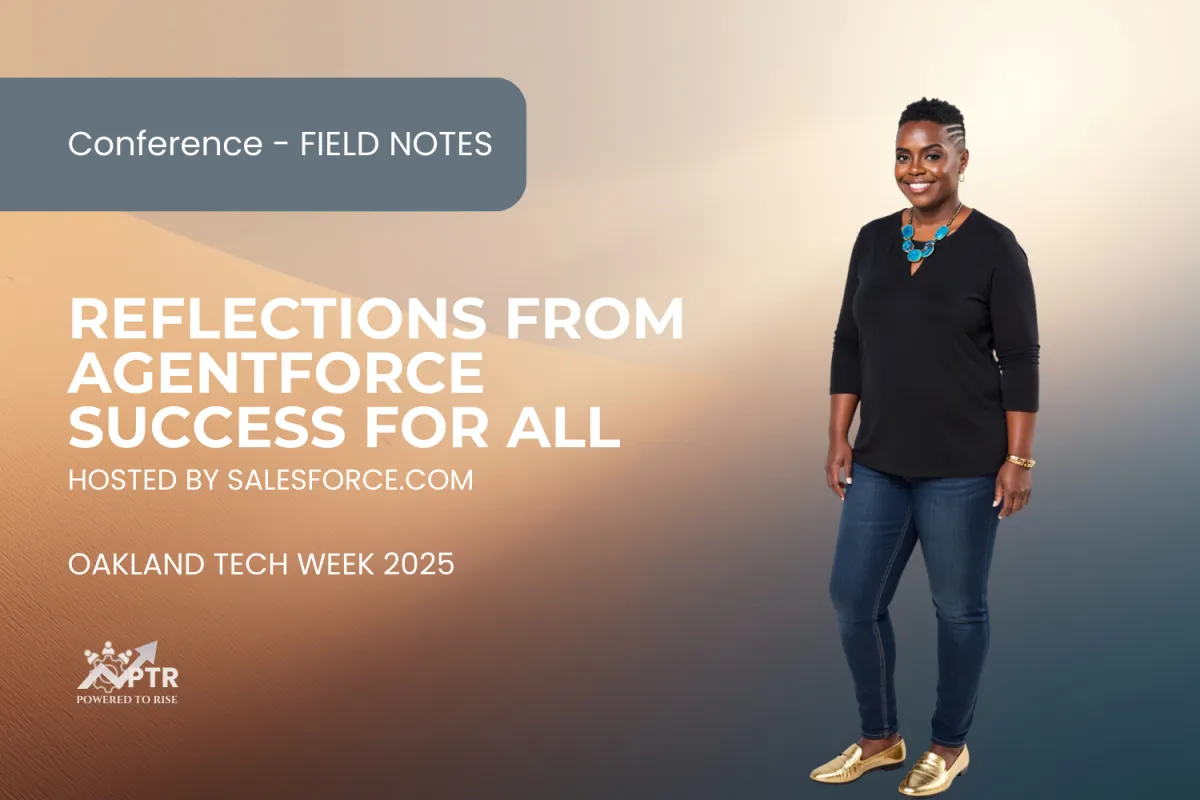
Reflections from Salesforce’s Agentforce - Success for All Gathering at Oakland Tech Week

Arrival: A Journey That Opened More Than One Door
I decided to travel to Oakland because Salesforce was hosting an Agentforce workshop during the city’s first-ever Tech Week. I saw this as a well-timed opportunity to deepen my certification journey on their platform. I had already completed the first stage online, and as someone who thinks constantly about adult learning, I believe that a concept lands differently when you experience it across multiple formats. The in-person session felt like the perfect opportunity to sit with the material in a new way.
Yet before I even reached the museum where the event was held, the city reminded me why place matters as much as technology and how our bodies recognize wisdom even before our minds ever register the thought.
The moment I stepped onto BART from the Oakland airport, something familiar settled into my being. I grew up in Chicago, riding the El everywhere. Public transit was not just a mode of transportation. It was a classroom of humanity. A community equalizer. A map of the city’s heartbeat. I experienced that same grounding energy on BART—clean stations, bright trains, routes that make sense to anyone who grew up moving through a city by rail. It made me feel at home before I had even arrived at my destination.
When I got off the train and decided to walk the neighborhood for a moment, I found myself wandering into the Oakland Library. Completely unplanned. On the top floor sat a quiet photo exhibit, a collage of Oakland’s early days—shipyards, migration stories, community moments captured on film. One image stopped me cold: Cesar Chavez standing beside Lionel Wilson, Oakland’s first African American mayor, dated March 29, 1977.
Two men who spent their lives fighting for dignity, labor rights, and racial equity. Two leaders from different communities who understood coalition as necessity. In that single photograph, I felt the through-line between Oakland’s past and its future. A reminder that this city has always been a site where communities of color reimagine what is possible.
When I finally made my way to the Oakland Museum and sat down for the Agentforce workshop, the universe placed one more layer on the experience. My session was led by a Black woman named Rosa.
Her name alone carried its own gravity. A name that belongs to the quiet warrior who changed the course of our nation through one simple act of refusal. Rosa Parks sat, and because she made that brave decision, the world was forced to stand up and re-examine who deserved access, dignity, and equal rights. For me, someone who has always admired the courage wrapped in that moment of stillness, there was something especially powerful about beginning this new chapter of my AI journey under the guidance of a woman who bore her name.
It felt symbolic. Almost ordained. As if the early steps of my own transition into a more technical future needed to be shepherded by someone who embodied, in her very presence, a lineage of resilience, discipline, and possibility. Rosa guided us through the tools, the concepts, the mechanics of building inside of Salesforce’s AI ecosystem. Yet what stayed with me was the weight of her leadership. A Black woman leading the technical training. A Black woman teaching me how to build within an AI platform. A Black woman holding the room with authority, clarity, and ease.
The session did more than teach me skills. It reminded me who I am and what I am capable of becoming.
I left that workshop with the sense that I had not simply attended a training. I had joined a lineage.
And as I stepped out into the museum atrium, surrounded by the buzz of Oakland Tech Week, I carried with me a truth that framed the rest of the day:
The future of AI is not abstract. It is personal. It is generational. It is already being shaped by the very people history tried to write out.
Oakland as the Gateway to the Bay Area’s Innovation Corridor
Oakland began shaping my experience long before I reached the doors of the museum. This city holds history and possibility in equal measure, and it became clear from the moment I arrived why Oakland is not simply part of the Bay Area’s story. It is the gateway into its future.
Oakland is not the midpoint between San Francisco and San Jose. It does something more powerful. It stands at the gateway to the entire Bay Area innovation corridor. San Francisco rises to the west. Silicon Valley stretches down the peninsula to the south. And to the northeast, Sacramento anchors statewide policymaking—shaping the regulatory and economic environment in which tech, BioTech, and healthcare organizations operate.
Oakland sits at the confluence of all three.
For someone whose work lives at the intersection of healthcare, digital technology, and public policy, this positioning is not symbolic. It is strategic. It is the rare place where breakthroughs, regulations, and lived experience all converge within reachable distance.
The region surrounding Oakland is one of the densest and most influential ecosystems in the world:
Global tech companies headquartered in San Francisco.
AI labs, venture-backed startups, and data-driven research institutions woven throughout the East Bay.
BioTech giants and healthcare innovators concentrated across the peninsula.
Universities such as Berkeley, Stanford, and UCSF pushing the frontier of science and engineering.
And the State Capitol in Sacramento shaping the policies that determine how these technologies are built, governed, and deployed.
California’s policy environment is one of the most progressive and forward-looking in the country. The state routinely leads on data privacy, healthcare reform, environmental protections, social programs, education, and AI governance. This alignment—industry, research, and policy—creates a fertile soil that is difficult for other states to replicate.
This is what makes Oakland an ideal anchor city for Powered to Rise. It is close enough to the innovation engines to influence change, grounded enough in community to keep equity at the center, and positioned within reach of Sacramento where decisions about AI regulation, healthcare funding, and digital transformation are shaped.
This realization made what unfolded inside the Salesforce event even more meaningful.
The diversity in the room was unlike anything I had experienced in previous tech convenings. I have walked into many spaces where the technology was advanced but the representation was not. Spaces where the ideas were visionary but the lived experience needed to build responsibly for my community was missing.
Oakland changed that.
The room held educators, youth organizations, community-based nonprofits, healthcare leaders, small business owners, developers of color, entrepreneurs transitioning from nontraditional backgrounds, and government officials. And within the Salesforce leadership itself, Black women were not only visible. They were guiding the programming, moderating the conversations, teaching the technical concepts, and shaping the arc of the day.
Representation was not ceremonial. It was operationally critical.
That presence shifted the atmosphere. It expanded the imagination of what AI can be in the hands of people whose perspectives have historically been overlooked. It validated why Oakland belongs at the center of the AI equity conversation.
This is why Oakland is rising to the top of Powered to Rise’s priority markets.
It stands as the tip of the spear where healthcare, digital technology, and policymaking innovation meet.
It is a place capable of designing solutions that work for everyone, not just the few.
And it is a region already building the kind of future we want to help shape.
If AI is going to transform healthcare, reimagine workforce mobility, and reshape how policy is implemented, then it must be anchored in cities like Oakland—cities that understand both the potential and pitfalls as solutions are designed.
In every way, Oakland is not the backdrop of this story.
It is the gateway.
Inside the Event — Where Community, Leadership, and the Agentforce Experience Converged
Stepping into the Oakland Museum for the Agentforce gathering felt like crossing a threshold. On one side of the street sat the library exhibit that carried the weight of Oakland’s past. On the other side, Salesforce had created a space that held the blueprint of its future. Entering that room felt like stepping into the intersection of history, opportunity, and responsibility.
The first thing that struck me was the diversity. The kind that shapes conversation, shifts energy, and redefines what is possible.
Educators sat alongside developers. Youth program leaders sat beside enterprise architects. Nonprofit directors, civic leaders, healthcare practitioners, small business owners, creatives, and technologists from every imaginable background filled the seats. Each person carried a different lived experience, yet all of us were drawn by the same magnetic pull: curiosity about AI, urgency about equity, and a desire to understand what it means to build the next chapter of our work with intention.
And in the midst of this room—full of community visionaries, technologists, and organizers—stood a woman whose presence carried the full weight of Oakland’s political and moral legacy: Barbara Lee, Oakland’s first Black woman mayor, a lifelong community activist, and one of the most respected voices in Congress when it comes to equity-centered policy.
Her keynote was not a ceremonial welcome. It was a grounding.
Barbara Lee has spent decades fighting for underserved communities, protecting civil liberties, advancing health equity, and shaping national debates. Her fingerprints are on countless pieces of policy that safeguard marginalized communities. Through her leadership within the Congressional Black Caucus, she helped usher in some of the earliest federal conversations around artificial intelligence, bias, ethics, and community protection.
To hear her speak about AI from the perspective of someone who has spent her entire career advocating for fairness, justice, and access was profoundly validating. She reminded us that technology does not exist in a vacuum. It sits inside social systems, economic systems, and policy systems that can either reinforce inequity or disrupt it. Leaders who understand those systems deeply—leaders like Barbara Lee—are critical to making sure emerging technologies do not repeat the harms of the past.
Her presence was also symbolic. Hours earlier, I had stood in the library staring at a 1977 photo of Cesar Chavez and Mayor Lionel Wilson—the city’s first Black mayor—standing side by side. Two men leading across community lines to create a more just world. Now here I was, facing a new chapter of Oakland’s leadership lineage. Another first. Another barrier broken. Another reminder that Oakland’s history of courageous, community-led leadership is still unfolding in real time.
What I felt in that room was not new, but it was rare. Representation is often framed as an endpoint—as if seeing someone who looks like us is the achievement. But representation, when done right, is not a signal of presence. It is a signal of power. A signal that diverse leaders are not only welcome but authorized and resourced to shape outcomes.
That truth was woven throughout the event.
Black women were not only visible. They were guiding the agenda, moderating the conversations, teaching the technical concepts, and shaping the day’s learning arc. The presence of a bench—not a representative individual—shifted the environment. It expanded the imagination of what AI can look like in the hands of communities who have historically been left out of the earliest stages of technological revolutions.
For me, that shift began with Rosa in the Agentforce workshop earlier that morning. To learn AI mechanics—agents, data flows, platform logic—from a Black woman was not simply a technical experience. It was a message. A reminder that we belong in the architect’s seat. A reminder that the future of AI must be shaped by people who understand both the technology and the communities it reaches.
The rest of the program followed that same through-line. Conversations were grounded, not abstract. Leaders discussed how AI is reshaping work in ways that demand not only new tools, but new skills and new forms of support. According to a report published by the World Economic Forum:
59 percent of the workforce will need re-skilling.
29 percent will need up-skilling in their current roles.
39 percent of core job skills will change.
14 percent of roles will be newly created by 2030.
These numbers represent real lives and real communities. In cities like Oakland, they represent communities that have historically been excluded from the earliest stages of economic and technological change.
This is what made the event so powerful. It brought together the entire ecosystem—industry, educators, youth developers, nonprofit practitioners, healthcare leaders, government officials, and community organizers—for a shared purpose: to understand what it means to ensure that everyone belongs in the future of AI.
The day did more than give me new information. It gave me alignment. It deepened my conviction that the work we are building at Powered to Rise is not only relevant. It is necessary. It is rooted in the right questions. It is deeply connected to the people, institutions, and leaders who were present in that room.
Inside the Agentforce gathering, I could feel the beginnings of what an equitable AI future requires:
Belonging. Representation. Data-affirming leadership. Community-grounded governance. A willingness to redesign systems that historically left too many behind.
Oakland showed what that looks like in real time.
Barbara Lee affirmed it.
Rosa embodied it.
And the Agentforce experience translated it into something actionable.
The Agentforce Workshop — AI as the Sidekick, Humans as the Heroes
I had already completed the first stage of the certification online. Those modules gave me the foundational concepts, the vocabulary, the structured learning that an independent learner like me deeply appreciates.
If the online module gave me clarity, the live workshop gave me conviction.
Rosa did not simply teach us how to navigate the interface or configure an agent. She taught the logic beneath the tool. She taught the “why,” not only the “how.” She did it in a way that honored the complexity of adult learners—people who may carry decades of experience in their fields yet are now navigating the language and mechanics of a rapidly shifting AI landscape. As someone who thinks constantly about adult learning and about how people metabolize information, it was refreshing to see that Salesforce had designed a pathway that meets people where they are instead of assuming one learning style fits all.
As we moved deeper into the workshop, I found myself returning to a framework I have carried for years:
Humans are the heroes. AI is the sidekick.
The more I learn about AI, the more convinced I am that the real work is not about training people to overcome the fear of replacement. It is about teaching people to see possibilities. AI does not diminish the human role. It clarifies it. It sharpens it. It removes the noise that keeps us from standing fully inside our brilliance.
This workshop reinforced that truth.
We learned how to structure an agent’s instructions, how to define its guardrails, how to guide its process. Yet what mattered most was not the mechanics—it was the mindset. Building an AI agent is less about technical skill and more about conceptual clarity:
What problem are you solving?
What decision-making logic does the agent need?
What data must be protected, anonymized, or excluded?
What are the ethical boundaries?
What outcome should be created for the human?
This is where I realized that the future of work is shifting not toward deeper technical specialization, but toward guided intelligence—humans who understand context, nuance, ethics, and process design.
We are moving from needing architects who build everything by hand to needing guides who can direct, prompt, validate, and correct AI systems so they produce work that is safe, accurate, and aligned with real-world outcomes.
These insights challenge us—and they also liberate us. They show that the world is not eliminating human work. It is redefining it. The value we bring is not our ability to perform repetitive tasks. AI will increasingly cover those. The value we bring is our insight. Our empathy. Our capacity to design. Our ability to understand complexity. Our ability to guide.
This is where the “AI as sidekick” narrative becomes essential. The human remains the protagonist. The human defines the problem. The human sets the ethical boundaries. The human decides what “good” looks like. AI exists to amplify what the human carries.
The workshop made this practical.
I saw clearly how AI can reduce the cognitive load of my work—the strategy, the architecture, the content design, the connective tissue between healthcare, technology, and policy. I also saw how important it is to understand the structure behind the scenes. You do not need to be a developer to build intelligently with AI. Yet understanding data mapping, relational logic, workflow design, and human-centered outcomes allows you to guide the technology with far greater precision.
This is why I see myself as an architect, not a developer. A bridge, not a coder. Someone who stands with a foot in multiple worlds so that communities who have been historically excluded from these rooms can find their way in.
The workshop reinforced a deeper truth I have been holding quietly for years:
We will not achieve equitable outcomes with AI unless people with community-rooted experience guide the systems that shape it.
This is the calling I walked away with.
Agentforce did more than teach me how to build. It showed me what is possible when tools are intentionally designed to be accessible. It reminded me that learning is not simply informational. It is transformational. It affirmed that the role I play—helping people see themselves as heroes in partnership with AI—is not only valuable. It is necessary.
As the workshop concluded, I felt the beginnings of a roadmap forming. A sense that the work I have been doing across healthcare, community organizations, technology, and policy is converging into something more focused, more articulate, and more aligned with where the world is headed.
This workshop was not the culmination of something.
It was the beginning.
From Workforce Transformation to Community Transformation — What AI Means for Equity, Policy, and the Future of Work
As the conversations shifted from the workshop to broader discussions about work, equity, and access, it became clear that AI is not only reshaping how tasks are performed. It is reshaping the systems in which people live, work, and seek support. That includes healthcare, public health, housing, education, social services, and the nonprofit organizations that sit at the heart of these community-support networks.
In communities like Oakland, the promise and pressure of this transition are both intensely visible. Many residents depend on services delivered by nonprofits and public health organizations already operating under enormous strain. Their leaders are navigating shifting policy landscapes, rising demand, limited staff capacity, and administrative burdens that have become heavier rather than lighter.
These organizations need help.
They need relief.
They need technology that genuinely lightens the load.
Salesforce sits in a uniquely powerful position to offer that support. Its infrastructure is already built to handle the complexity, security, and scale that healthcare-adjacent organizations and social services require. The challenge is not whether the tools exist. The challenge is how to make them usable and accessible for organizations whose missions pull them in a thousand directions every day.
This is where the conversation must shift from “adoption” to partnership.
Most nonprofits, especially those serving public health and essential community programs, cannot carry the burden of becoming their own systems integrators. They do not have the time, staff, or cognitive bandwidth to architect full CRM platforms, automate workflows, or design secure AI-driven systems. Their expertise lies in direct service, care coordination, advocacy, and community-based work—the very roles that keep people alive, housed, fed, and supported.
Expecting them to take on the complexity of architecture and implementation of digital ecosystems is not only unrealistic. It is unfair.
The solution is to simplify their experience with technology.
Which means nonprofits need strategic partners—teams who understand the Salesforce ecosystem, who can architect responsibly, who can design with privacy in mind, and who can translate the nuances of public health and social services into digital tools that genuinely support the mission.
This is where I see a clear and necessary role for the next chapter of my corporate career, and as an extension, the work I do through Powered to Rise.
Our focus has always lived at the intersection of public healthcare, policy, and digital technology. As we evolve our digital ecosystem frameworks, it is becoming increasingly obvious that there is a tremendous opportunity to integrate with platforms like Salesforce—platforms that already have enterprise-grade infrastructure, AI capacity, and data protection layers strong enough to handle highly regulated environments containing sensitive information like health and education records.
The call is to support rather than replace what nonprofits are doing. It is to build AI-enabled tools that lighten the administrative burden, create clarity in their data, improve coordination, and help teams reclaim time and capacity for their core mission.
This requires participation from nonprofit leaders—not to build the tools, but to inform their design and usability.
We need their insight. Their context. Their experience.
The build itself should be executed by specialists who understand how to maximize the architecture.
This approach honors the lived reality of nonprofit work. It meets organizations where they are with resources that handle the mundane, repetitive tasks to preserve their energy for doing the work that can only be done by humans with compassion and caring for those who need support.
This is what the Agentforce event illuminated for me: AI will not transform communities through tools alone. It will transform communities through collaboration—industry, policy, technical expertise, and community wisdom working together to create systems that distribute resources and relief.
The future of work cannot be separated from the future of care.
The future of care cannot be separated from the future of technology.
None of these futures can move forward responsibly without policy that protects people at the margins.
This is the work ahead.
This is where I am called to lead.
This is why Oakland—and the broader Bay Area innovation corridor—matter so deeply to the next chapter of our mission.
Alignment, Aspiration, and the Future of Powered to Rise
As the event came to a close, what stayed with me most was not only what I learned, but what I recognized. The ideas, commitments, and values I witnessed throughout the day were not foreign to me. They represent similar principles that have guided Powered to Rise since the beginning—equity, access, integrity, and a belief that technology must strengthen, not strain, the people and systems we care about.
What shifted in Oakland was not my vision. It deepened my understanding of how that vision could unfold over time.
Powered to Rise will continue supporting solopreneurs and private practitioners, designing enablement tools and digital ecosystems that clarify their work, strengthen their operations, and multiply their impact. Through these services, we activate more small businesses owned by Black Women. More importantly, we develop more leaders from within our community and equip them to become architects who shape the future of policy design and resource allocation.
As I continue building the long-term vision of what Powered to Rise will become, my immediate focus is on identifying my next career strategic partnership. I aim to support enterprise-level adoption of AI from within an organization that aligns with my values—a role that allows me to serve as a bridge between technology, community, and equitable systems change. I imagine a day when I close the chapter of my corporate career and enter a phase serving as an advisor on policy development and teaching within an academic setting, most likely an HBCU. The next 10–15 years of my career will be spent developing the lens of how technology shapes human-centered work in preparation for this call.
In many ways, this dual journey—continuing to serve private clients while deepening my technical fluency—creates a natural evolution. As I grow within the Salesforce training ecosystem- Trailhead Academy, I can already see how my own work may eventually migrate into that ecosystem. I'm building my plans gradually, responsibly, and with financial and structural support to build the right kind of foundation for the future I want all Black Women to experience.
And while Powered to Rise does not serve nonprofits as clients, our mission has always included a commitment to strengthening public healthcare systems and the organizations that support them. That commitment is rooted in service. It is rooted in values. It is rooted in the understanding that improving health outcomes will not be attained without addressing the social determinants of health that surround them—and that technology that builds pathways to higher wages - is a direct throughline to many of them.
This is why I can imagine a future where Powered to Rise builds AI tools that support nonprofit missions—not as a revenue stream, but as an extension of our passion for building solutions that improve public health, expand access to care, and support the workers who hold our communities together. Perhaps that looks like AI agents that help teams navigate grant writing. Perhaps it looks like tools that simplify data storytelling or strengthen community outreach. The possibilities are expansive.
What I know for sure is that I want Black women, and all those historically left out of tech’s inner rooms, to find themselves in ecosystems where they are not only present, but safe, seen, and resourced to lead. The leadership bench I witnessed at Salesforce—Black women leading at scale, in public, with authority—is a glimpse of the kind of environment I want to help more of us access.
The Invitation, the Vision, and the Path Forward
When I arrived in Oakland, I thought I was coming for a workshop. I thought I was coming to deepen my understanding of Agentforce. I thought I was coming to gather a few insights I could carry back into my work.
I left Oakland with something far more profound.
I left with a reminder that the future of AI is not being shaped in distant rooms by people we will never meet. It is being shaped by communities, by leaders rooted in justice, by educators and youth advocates, by people who believe deeply in the dignity of work and the power of possibility. I left with a clearer sense of how my story fits inside this moment—and how Powered to Rise can continue evolving without compromising its integrity.
I left with alignment.
The alignment that comes when your values meet the right ecosystem.
The alignment that comes when history, community, and technology are in conversation.
The alignment that comes when a city like Oakland shows you, by example, how belonging is built from the inside out.
This event affirmed that everyone deserves a seat in the future of AI.
Not because AI is the destination, but because AI is the next landscape in which our humanity must be protected, expanded, and celebrated.
It reminded me that the work I execute in the next chapter of my career—and the work of Powered to Rise—is ultimately about connection.
Connection between story and system.
Between policy and people.
Between community needs and technological possibilities.
Between the worlds I have lived in and the future I am being called into.
It reminded me that this next chapter is not about choosing between Powered to Rise and the enterprise ecosystem I hope to serve. It is about honoring both paths as they unfold. One grounded in private practice and community support. The other rooted in enterprise-level AI adoption, equity-centered leadership, and a desire to help guide the responsible use of technology at scale.
Oakland brought all of these truths forward.
Rosa’s leadership showed me what it looks like when Black women hold the technical container.
Barbara Lee’s presence showed me what it looks like when policy and community remain inseparable.
The diversity in the room showed me what it looks like when the people who have been left out of so many rooms are finally centered.
The workshop showed me what AI can become when humans remain the heroes of the story.
Every moment reminded me that this work—the work we are building now and the work still taking shape in the distance—is not about tools.
It is about people.
It is about belonging.
It is about designing a future in which everyone has the opportunity to thrive.
So here is my closing invitation:
Stay curious.
Stay open to what AI can unlock when we insist on human-centered design.
Stay rooted in community even as you reach toward innovation.
Stay committed to building systems that honor the people they are meant to serve.
And stay connected to the belief that the future of work belongs to all of us—not just the ones who have traditionally been at the table.
This is the future Oakland showed me.
This is the future Salesforce is helping shape.
This is the future Powered to Rise is committed to making possible for more members of the Black community.
The work ahead is big.
The opportunity is extraordinary.
We were made for a moment such as this.
Sources & Further Reading
Salesforce: Agentforce Success for All: Oakland
https://www.salesforce.com/blog/agentforce-success-for-all-oakland/
Salesforce: Salesforce Expands Free AI Training Opportunities
https://www.salesforce.com/news/press-releases/2024/09/18/ai-training-opportunities/
Oakland Tech Week
World Economic Forum: The Future of Jobs Report 2025
https://www.weforum.org/publications/the-future-of-jobs-report-2025/
City of Oakland: Barbara Lee Sworn in as Oakland’s 52nd Mayor
https://www.oaklandca.gov/News-Releases/Barbara-Lee-Sworn-in-as-Oaklands-52nd-Mayor#:~:text=Oakland Mayor Barbara Lee has,in the California State Legislature
Nextgov: Congressional Black Caucus Launches AI Policy Series Spotlighting Discrimination


