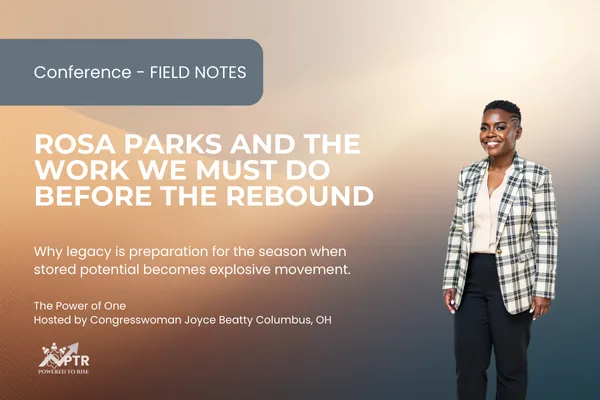
Sitting Down to Stand Up: Lessons from a Rosa Parks Celebration

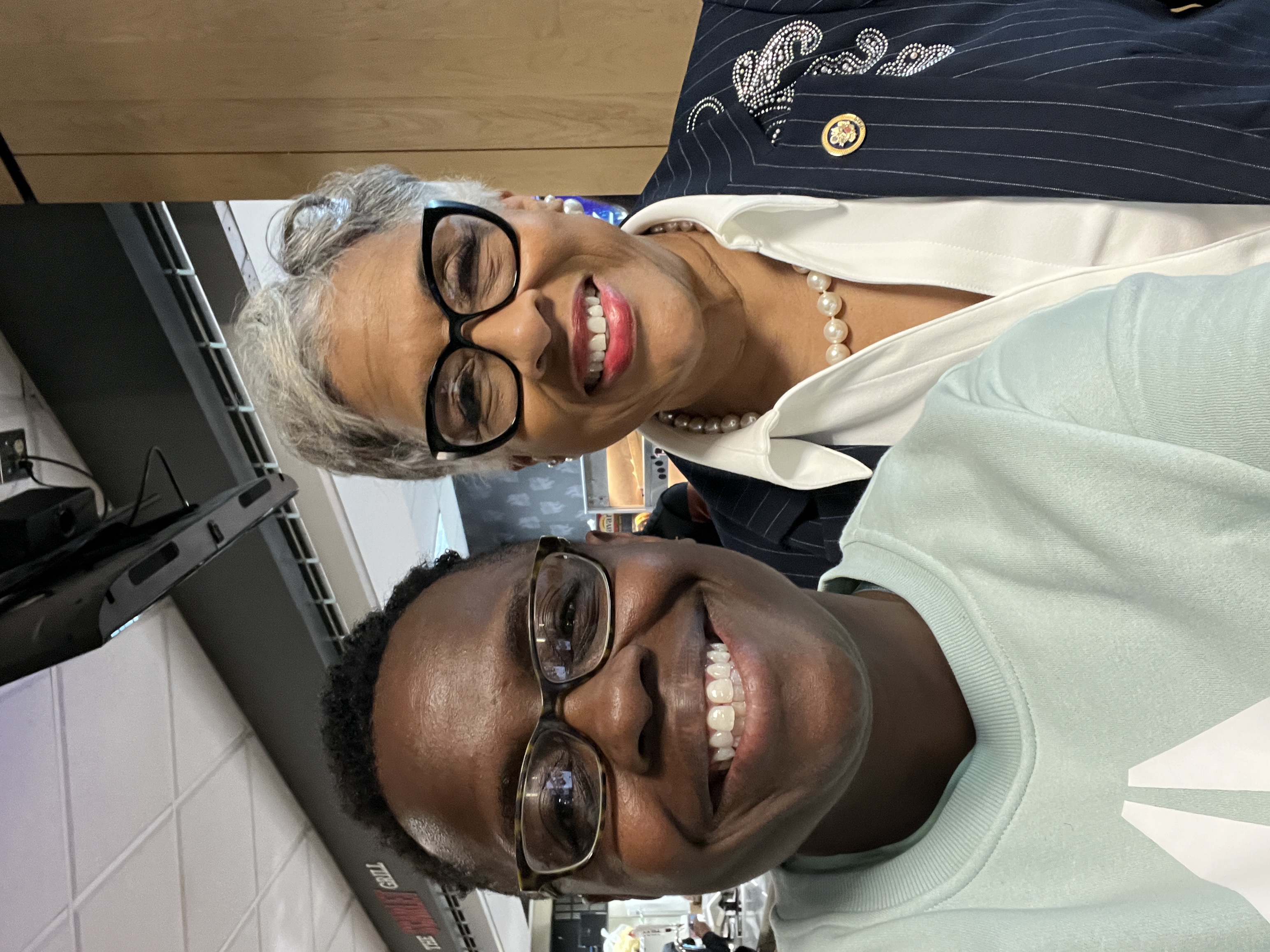
I spent this past weekend in Columbus, attending an event hosted byCongresswoman Joyce Beatty to celebrate the legacy of Rosa Parks. You can watch the full program here.
Life has taught me that energy is our most precious resource. Even rarer than time itself is the quality of energy we bring to our time - what we have the capacity to build. Political engagement doesn't activate my gifts or renew my energy. Yet I've learned there is no pathway to strengthening historically under-resourced communities that doesn't run directly through studying, engaging, and redesigning our political systems. This event reminded me why.
The room held an interesting cross-section of power. James Clyburn was there, sharing the history of Jim Crow laws and reminding us how electoral systems can be weaponized to silence communities. Ed Gordy, someone I grew up watching, moderated the conversation. The president of Ohio State University sat among the attendees, later recognized by Congresswoman Beatty as a partner in serving her constituents through workforce development programs and technology that improves daily lives.
Then came a moment that crystallized why I'd made the trip. Former Governor Bob Taft was presented with a plaque. Twenty years ago, when Congresswoman Beatty led the charge to get Rosa Parks Day legislation voted through the Ohio legislative session, it was Taft who signed it into law. The plaque commemorated that moment and served as a living reminder: bipartisan relationships aren't just nice to have. They're required up and down the political organization chart if you want legislation that lasts.
This is how power actually works. Not in grand speeches or viral moments, but in the quiet, persistent work of building coalitions that can turn values into law. Congresswoman Beatty has been doing this for twenty years, and the fact that a Republican governor stood with her two decades ago is why Rosa Parks Day is still honored across Ohio today.
What struck me most wasn't just the celebration of legacy, though. It was the growing clarity about what's on the line in 2026.
Where I learned to Read Policy Maps
I didn't always follow politics this closely. Before the pandemic, I voted in presidential elections but didn't track what was happening in between. Then COVID-19 arrived, and suddenly the connection between policy and survival became impossible to ignore.
The people who lived and died during that crisis weren't chosen randomly. They were determined by policy decisions made decades before the crisis hit. Who had access to healthcare? Whose neighborhoods had been systematically disinvested from? Which communities had the economic resources to weather shutdowns? Those outcomes were engineered through years of choices, and when the crisis arrived, those choices became visible in mortality rates.
That's what keeps me up at night now. When I look at the policy decisions being made today—the dismantling of public health infrastructure, the attacks on education, the efforts to declassify professional designations in nursing and other fields where Black people have built careers—I see a map. Not scattered, isolated changes, but a coordinated effort to recreate conditions that will devastate communities of color when the next crisis arrives.
The next pandemic isn't a question of if. It's when.
When it comes, who will be in the rooms making decisions? Who will have designed the systems that determine who gets resources, who gets seen, and who gets served?
When the Jobs Come Back, Will We Be There?
The same pattern shows up in workforce development. We are living through a technological transformation, and I am deeply concerned about whether Black communities and other communities of color are being prepared to design the future or simply survive it.
The job economy behaves like a coil.
During a season of retraction, it tightens. Jobs disappear. Budgets pull inward. What looks like loss on the surface is actually the economy conserving energy—gathering potential power beneath the pressure. Inside boardrooms across the country, leaders are forecasting, debating, and redesigning the kind of workforce they believe will fuel their next wave of growth. That compression phase becomes stored potential energy.
Eventually, the tension shifts.
Every coil has a release point. When the economy moves from conservation to expansion, the stored potential becomes kinetic—energy in motion. Growth surges. New roles uncoil rapidly. Entire industries accelerate as companies race to operationalize the strategies they developed in the quiet.
Right now, we are in the compression phase. Jobs are disappearing; that part is visible. What is less visible is the moment that follows. The market will reset—it always does. The expansion will come. The release always comes.
The real question is whether we will be ready when it does.
Because the jobs that return will not be the same as the jobs we lost. They will require people who know how to maneuver technology, wield it, build with it, and adapt quickly as AI reshapes every sector.
Here is my fear: If our communities are not intentionally building tech skills now—during the compression—we will miss the moment of release. We will be out of position just as the surge of new opportunity begins.
This is bigger than individual careers. It is about economic mobility for entire communities. It is about whether we are shaping the systems of the future or simply being shaped by them, whether we are designing the architecture or merely operating inside it.
It is about agency.
A Leader Who Fights in the Halls and the Streets
I started paying closer attention to Congresswoman Beatty during the pandemic. It wasn't because I suddenly loved politics—I'm still allergic to the pomp and circumstance, the backroom wheeling and dealing. What drew me in was seeing her get arrested while protesting in the streets during the Black Lives Matter movement.
She was out there, in the midst of a public health crisis, going to jail to fight for our rights. That moved something in me. It made me appreciate leaders who will fight in the halls and in the streets.
Being at her Rosa Parks celebration this weekend reminded me that we all have different roles to play. My path isn't running for office. I'm clear about that.
My contribution is different. Through Powered to Rise, I'm building the digital infrastructure that equips leaders within Black communities to vocalize their thought leadership and be visible about the work they're building on the ground. I'm also in a season of strategically positioning for my next corporate role, where I can create a partnership to bring technology skills and resources to communities of color while holding my identity as a business owner. All of it keeps me focused on the same overarching lens: shifting policy to strengthen our historically under-resourced communities.
The work is about paving a runway for leaders like Congresswoman Beatty to take off from. But none of that work succeeds without the right people in power to protect it through policy.
The Maps They're Drawing in Back Rooms
Let me be direct about what's happening right now. District maps are being redrawn. This isn't about winning elections based on majority opinion or popular vote. It's strategic wargaming—how to secure seats with candidates who don't represent majority sentiment but can maintain radical perspectives through electoral manipulation.
The average person isn't thinking about this. I don't want to be thinking about it. I have a million other things I'd rather focus on. But if we want our communities to thrive, somebody has to pay attention to how power is being consolidated and how we can create resources to level the playing field.
This is why the 2026 midterms require nontraditional thinking as we build our new roadmaps.
Reimagining Slavery Through Policy
If you're going to recreate systems of inequality without literally reconstructing slavery, here's what you might do:
Limit public infrastructure like Medicaid programs
Dismantle education access and quality
Push good jobs into an elite category that requires credentials most people can't access
Declassify professional designations in fields where Black people have built careers—nursing, public health, supplemental medical roles—making them second-class positions within their industries
Restrict pathways to higher education while claiming you're just removing barriers
Look at the totality of the policy map. Come up to the 50,000-foot view. Ask yourself: Ten years from now, when the next pandemic hits and all of these policies have been fully implemented, what happens to communities of color?
If left unchecked, we could be looking at a different form of genocide through policy.
I don't say that lightly. I hate having conversations like this. But my passion for this work has nothing to do with who gets attention or who's moving and shaking in political circles. I care about who's going to live through the next pandemic. I care about what happens to our kids when the job market expands back and they're not prepared to participate in that expansion.
Charting the Course Together
One thing the Rosa Parks celebration highlighted for me: This work requires all of us playing different roles. The room itself was proof of that. Black media. Congressional Black Caucus members. The president of a major university actively partnering on workforce development and technology access. A former Republican governor being honored for work he did with a Black Democratic congresswoman twenty years ago. We need to shore up strength within Black communities. We've been fractured by events like the pandemic, and rebuilding that internal village is critical. But we also need to build partnerships with people who sit in places of power—university presidents, governors, allies who can share and redistribute power. That's what Congresswoman Beatty demonstrated when she worked across the aisle to get Rosa Parks Day established in Ohio. That's what she continues to demonstrate by partnering with Ohio State on programs that directly serve her constituents. The work isn't about ideology for its own sake. It's about charting a new course toward policies and programs that improve people's lives. It's not either/or. It's both/and. We need Black media elevating our stories. We need congressional leaders fighting in the halls. We need state legislative leaders and regulators holding the line. We need allies partnering in bipartisan ways, even when the times make that feel impossible. We need corporate partners to sponsor and support the building of this work. We need community-based organizations leading on the ground and advising new programs. And we need people like me—who see around corners, who can forecast what's coming, and who help create pathways by connecting all the players on the field so our communities are ready when the moment arrives.
Why 2026 Has to Be the Priority
I'd rather focus all of my attention on building workforce development programs. I'd rather be deeply thinking about how to position Black communities for the technological transformation that's coming. I'd rather be creating pathways for the next generation to be architects instead of just participants.
But none of that matters if we don't have the right people casting votes in 2026 legislative sessions.
The upcoming midterms are pivotal elections. They're the foundation that determines whether any of our other work can survive. Without policy protection, without people in voting seats who will fight for our communities, everything else becomes exponentially harder—if not impossible.
So here's what I'm committing to: 2026 has to be about the midterms. Even though it's not where my heart naturally wants to focus. Even though there are a thousand other things calling for attention. Nothing else moves if we don't get this right.
Congresswoman Beatty has been doing this work for twenty years. James Clyburn has been holding the line for longer. Leaders like stepping into new roles that need to be elevated and supported. Leaders likeHakeem Jeffries are stepping into new roles that need to be elevated and supported.
The least I can do is make sure the behind-the-scenes infrastructure is there to support them. Make sure our communities understand what's at stake. Make sure we're building the resources and networks that help turn out the vote and protect the policies that will determine who lives and who dies in the next crisis.
That's not hyperbole. That's just reading the map.
What We Carry Forward
So yes, I'll be thinking about workforce development. Yes, I'll be building pathways for Black communities to acquire technology skills. Yes, I'll be doing the strategic forecasting work that I'm built for.
But I'll be doing all of it with one eye on 2026 elections. If we don't get the midterms right, none of the rest matters.
Rosa Parks sat down on a bus to make her stand. She was part of a coordinated movement that understood how power works and how to challenge it strategically. Her courageous act inspired countless leaders watching her sacrifice and planted seeds that continue to grow.
Congresswoman Beatty has spent two decades making sure our entire nation remembers that legacy. I'm proud to say that I spent nine years living within her district. She not only saw me—she stood up and fought for my rights long before she ever met me.
Now it's our turn to remember. And to act.


